


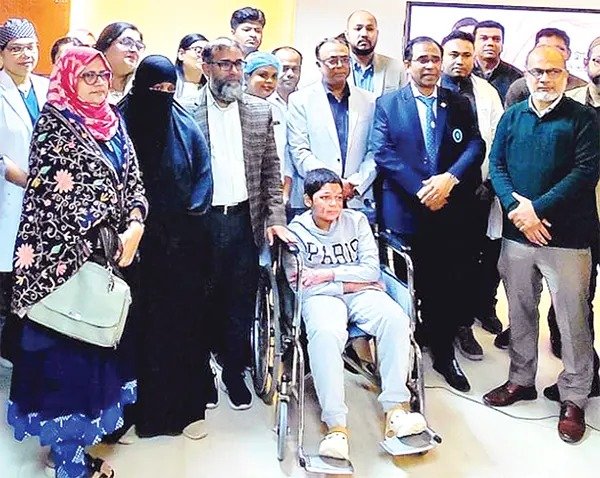
A little 11-year-old has waged a fight for 183 days that no child should ever face. Pain and fear and the omnipresent risk of death turned into a constant everyday business for him. But relief rolls in around today for the nation.
Last hospitalised victim released from hospital after six months: The last remaining hospitalised victim of a deadly fighter jet crash at Uttara’s Milestone School & College, Abidur Rahim Abid, has been released from treatment after almost six months of intensive care. His release not just closes a medical chapter but also shuts one of the saddest national catastrophes Bangladesh has seen in recent history.
But this is not a mere story of survival.
It is a story of human fortitude, medical devotion, and a chilling reminder of how precarious public health can be.
The Day That Shook a Nation
21 July 2025—a day etched into the national psyche of Bangladesh.
That day, an Air Force fighter jet slammed into the building of Milestone School & College in Uttara, transforming a normal day of learning into one with smoke and screams, fire and lives altered forever. In seconds, classrooms were reduced to rubble and the innocent victims of an unthinkable calamity.
One of those who were wounded was Abid, then 11 years old, and soon to prove the longest-standing survivor of the massacre.
183 Days of a Child’s Fight
The ICUBU (ICU and burn unit) of the National Institute of Burn and Plastic Surgery (NIBPS) became Abid’s world after the accident. According to doctors, Abid suffered:
22% burn injuries
He sustained a severe injury to his airway and lungs.
Critical injuries to both hands
A potentially deadly condition called Compartment Syndrome, which can permanently injure muscles and nerves — and even require limbs to be amputated if left untreated.
Each day was both a test of the boy’s fortitude and of the nation’s healthcare system.
His survival was never guaranteed. Any one infection or one setback could have been different.
Yet Abid continued to fight.
The White Coats in the Room of Silent Heroes
The reprieve of Abid is being hailed as a milestone in the treatment of burns and emergency care.
Resident surgeon at NIBPS, Dr Shawon Bin Rahman, informed us that Abid was formally discharged on Wednesday, after months of round-the-clock monitoring, continuous procedures, and rehabilitation planning.
Behind this expulsion there is the work of:
burn specialists.
plastic surgeons
ICU doctors
nurses and ward staff
therapists and support teams
It wasn’t one miracle moment. It was 183 days of relentless, consistent work, a process that often included painful procedures, emotional meltdowns and the sort of patience only frontline medical workers can understand.
In a country where medical professionals are rarely given their due, Abid’s story is a tribute to the adage: when talent combines with dedication, lives can be wrested from the grip of misfortune.
The Medical Chapter of the Tragedy Closes—But Not the Wound
With Abid’s discharge, all 36 of the injured victims in the crash have now received treatment and left the hospital.
But the tragedy is not only in the number of survivors.
The pilot and 35 other people on board were killed in the crash. Families were destroyed in seconds. Children lost friends. Parents lost children. Teachers lost students. Survivors carried scars — sometimes visible, sometimes not.
Those losses can never be reversed by any amount of medical recovery.
This tragedy is one of the worst aviation accidents in recent history in Bangladesh, and questions linger, and emotions run deep.
A Victory for Medicine, a Test of National Duty
Abid Bigyang walking out of the hospital is a victory. ” There’s no question.
It symbolises:
The power of contemporary burn care
The capacity of the medical institutes available in Bangladesh
The spirit of a family that refused to let go.
But his journey also raises questions about aviation safety anew, particularly in densely populated urban areas.
Many citizens are now asking:
How safe is low-altitude aviation in places teeming with schools and homes?
Are existing safety protocols enough?
Were risk assessments ignored?
What has been done to make sure this never happens again?
Disasters like this one don’t stop at the crash itself. They are about prevention, accountability, and what a society deems human life to be worth.
Abid survived.
But 35 families went back home, permanently empty.
A Child Comes Home, but a Country Remembers
Abidur Rahim Abid’s homecoming is an emotional one not only for his family but for the entire country.
He is being referred to now as the “last warrior” of the Milestone catastrophe, a boy whose survival seems almost emblematic: the last light in months of darkness.
But recovery doesn’t stop at discharge.
Abid will likely face:
long-term rehabilitation on mental health challenges trauma-related fear subsequent burn scars and hand injury surgeries or therapy His adventure goes on, but now with hope.
Final Words
Today, we celebrate Abid.
We salute the doctors and nurses, the medical researchers, and the first responders who fought with him.
And we regret all those who managed to come home.
This tragedy delivered Bangladesh a bitter lesson but also revealed how strong humanity can be when it refuses to give up.
May Abid outgrow pain and outgrow scars, toward a life of peace.
And may we, as a nation, never forget what this day cost us—so that it will never happen again.


