


Landscape Analysis Post-2026 Elections
By: Sham Islam | Bengali Roots Magazine | February 2026
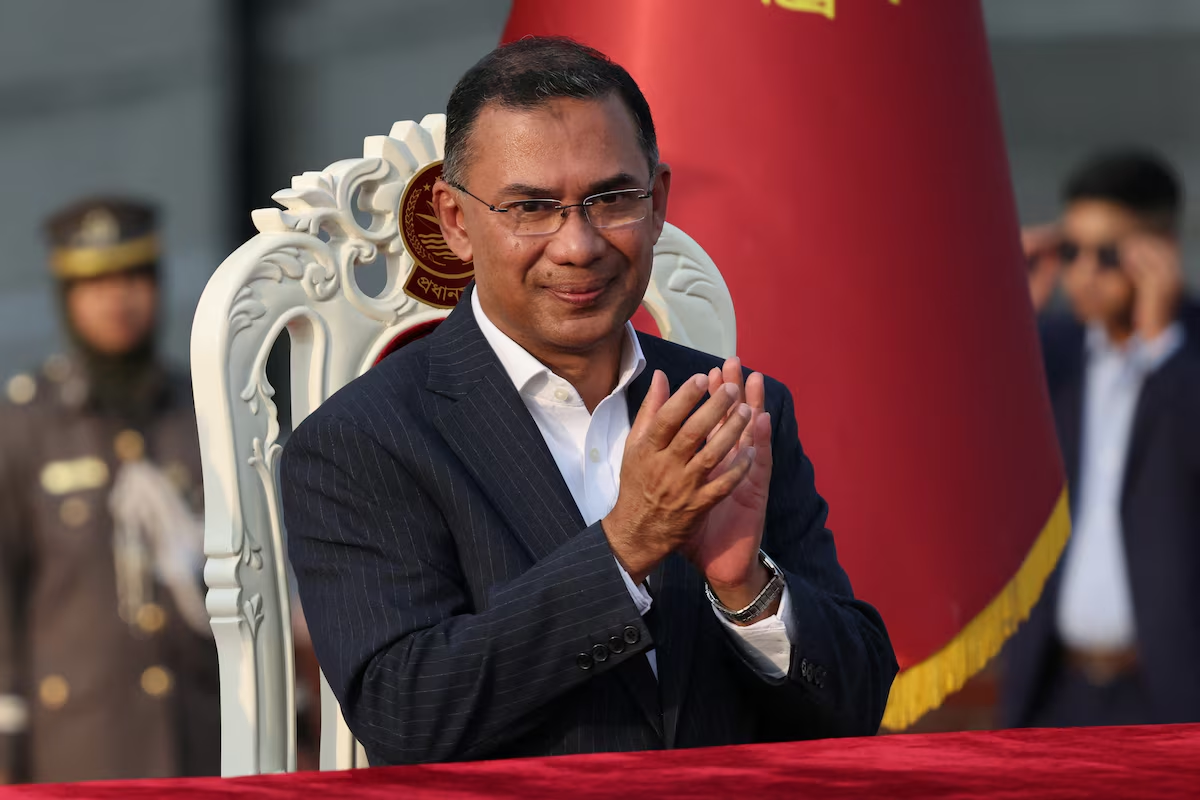
Bangladesh is set to embark on a new political chapter following the 2026 general elections. Despite a hard-fought yet largely peaceful electoral process, a new government has just taken office, bringing with it an important shift in the country’s governance landscape.
An orderly transfer of power, a linchpin of democratic stability, has thus far been widely regarded as a positive sign. For countless citizens, this smooth inauguration ceremony meant far more than ceremonial compliance with the Constitution; in a region frequently given over to political volatility, it meant the continuation of democracy as their elemental policy.
But once the ceremony ended and headlines ceased, the real test began.
The Context: Why 2026 Is Significant
2026’s election was no mere ballot cycle but a watershed, made inevitable by more than the usual years of complex political manoeuvring and deteriorating economic conditions, borne of public hope entrenchment.
Key themes dominated the campaign scene:
Governance and institutional reform
Economic stability and job creation
Controlling inflation and keeping living standards up
Social harmony and civil liberties
Helping young people in what is demographically a youthful nation
With more than a third of its population younger than 25, Bangladesh’s political fortunes will increasingly be tied to the aspirations of its youth. The electorate’s instructions to its representatives reflect not only party preference but also a broad agenda for accountability and tangible output from government.
The new government inherits a host of high expectations and structural challenges – from potential global economic disarray to domestic administrative reform.
The First Weeks: Setting the Tone
The new government hit the ground running, with a frenzy of administrative activity characterising its inaugural days. The Cabinet’s assembly was quickly completed, and key portfolios, including finance, trade, and home affairs, were given strategic placements.
Political observers have been eager to see:
The composition of the Cabinet (practical experience as opposed to new leadership)
Appointments of advisors and technocrats
Signs of economic reform priority
The first diplomatic contacts
Early Policy Signals
What has the government indicated in the past and done so far? In its opening speeches and early steps, the government has
pushed forward:
Economic reform and fiscal discipline
Cosying up to international financial institutions
Continued efforts to streamline all kinds of inefficiencies
New focus on trade and the kamikaze investments into China, as we heard
These early signals suggest a technocratic drift, at least in economic management, aimed at reassuring both domestic markets and international partners.
This, however, may not be enough.
Public Mood: Hopeful But Prudent
The public mood seems cautiously optimistic.
Initial opinion trends and public conversation are characterised by:
Hope for economic stability.
Demand for jobs.
Expectation of higher-quality services.
Desire for an anti-corruption drive with some bite.
Optimism, alas, is tempered by experience.
Many are heard to say, ‘We have already made changes.’ What we need now is results.
Elsewhere, some men are still worried, for example, about:
Protection of civil liberties
Openness in government
The pace and apparent authenticity of reforms
Said to be in a state of ‘honeymoon”, a political generation tells us that this is the time when public support can be won or lost.
Stakes for the Economy: Immediate
How well the government manages economic development will probably determine early impressions of it.
Bangladesh faces a series of urgent economic problems:
Inflationary pressures
Reserves of foreign exchange
Unemployment among young people
Public confidence in the private sector
To the business community, the new people are not without their attention. Trade groups and investors
have particular concerns about
Regulation reform
Easy business arrangements
Building infrastructure
Policy for trading diversification
But internationally, the peaceful power transfer has helped give Bangladesh a reputation not only for political stability but also as an economic mainstay, home to many foreign investments.
If the government can turn policy rhetoric into verifiable economic results, this might win it greater public confidence: a big if! Or the political future. The opposition’s role will be crucial to democratic conversation in the years ahead. A democratic regime needs not just good governance but also effective supervision.
The questions that remain unanswered and that the opportunity offers are: Can the government still be transparent in the reform process?
Is parliamentary discussion also constructive, or does this go the same way and become ever more strained and pointed?
How comprehensive will consultations about policy be?
How can national confidence be preserved in the face of ideological difference? Over time, citizens of Bangladesh have become more digitally connected, increasingly informed, and increasingly vocal on questions of governance quality. The newly installed leadership will need to reckon with heightened scrutiny.
A Country in Transition: Bangladesh today is not only presenting new governments; it is also raising new expectations.
The holding of this national representative conference in 2026 and the proper transfer of power it signified mark an important democratic step. But how this moment will be read is not simply a surface reading to be placed on its stability; it is, in fact, policy reforms, systematising those gains for people living out their everyday lives, which, being put in touch with anything givable for us at a large scale, could yet possibly mean.


