


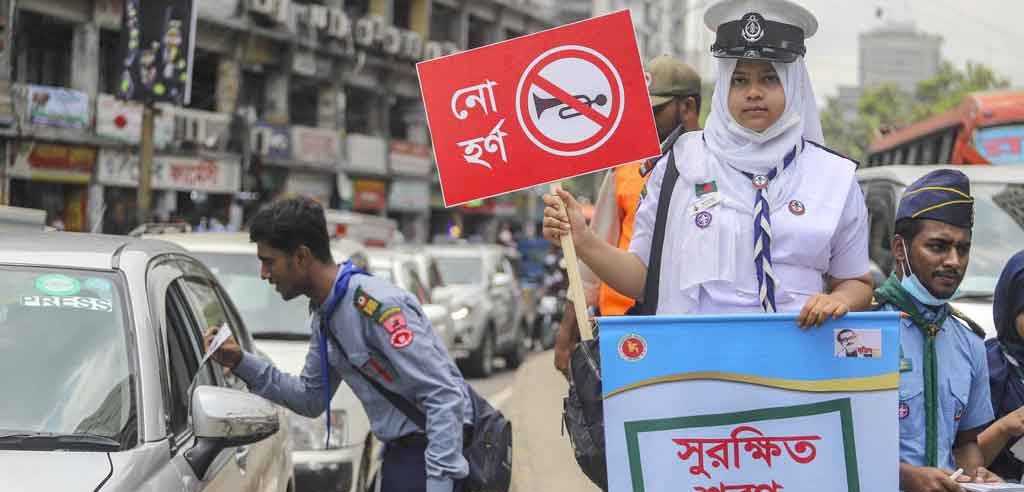
Jail and Heavy Fines from 25 January
If you think Dhaka’s constant horn-blaring has become unbearable, there’s major news for you.
From 25 January 2026, honking in several key areas of the capital could lead to serious punishment—including a hefty fine of up to Tk 10,000, and even up to three months in jail. In a bold move to curb noise pollution, the Dhaka Metropolitan Police (DMP) is adopting a “zero tolerance” approach in designated zones
# Especially around Hazrat Shahjalal International Airport and elite residential areas like Gulshan and Banani.
The question is: where exactly will honking be prohibited, and what happens if drivers break the rule? Here’s everything you need to know.
A Big Step Toward a Quieter Dhaka
Noise pollution has long been one of Dhaka’s most overlooked public health crises. The city’s streets are filled with horns—often used unnecessarily, aggressively, and habitually. While traffic congestion remains a persistent reality, experts frequently point out that excessive honking does not solve jams—it only increases stress, discomfort, and health risks.
To address this, DMP has announced that from 25 January 2026, certain areas will officially function as “Silent Zones” (or “soundless zones”), where using vehicle horns will be strictly prohibited.
This initiative is part of a wider enforcement push under the Noise Pollution (Control) Regulations 2025, under which these areas were formally declared Silent Zones last September.
Now, Dhaka is preparing to enforce these rules not just on paper, but in real traffic conditions.
Punishment for Honking: Fine, Jail, or Both
Under the new enforcement drive, violating the Silent Zone restriction will not be treated lightly.
According to DMP, those who honk in these zones may face:
- A fine of up to Tk 10,000
- Up to three months of imprisonment, depending on the severity
- Or both fine and jail together
This is one of the strictest anti-honking measures introduced in Dhaka in recent years, sending a clear message: unnecessary honking is no longer “normal”, it is punishable.
Which Areas Are Declared Silent Zones?
The new restriction will apply to some of the most high-profile and sensitive zones in Dhaka. According to the DMP announcement, honking will be completely banned in:
1) Hazrat Shahjalal International Airport Area
The airport zone is a priority due to heavy traffic, frequent congestion, and constant vehicle movement, including public transport and private cars.
2) Scholastica School to Le Méridien Hotel Corridor
A 1.5-kilometre north-south stretch from Scholastica School to Hotel Le Méridien is included in the Silent Zone coverage.
This area is characterised by major road traffic, VIP movements, educational institutions, and sensitive facilities, making it a crucial point for noise control.
3) Gulshan, Banani, Baridhara, and Niketan
The ban will also apply across Dhaka’s most prominent upscale residential and diplomatic neighbourhoods:
- Gulshan
- Banani
- Baridhara
- Niketan
These areas are home to embassies, schools, hospitals, and residential zones where noise pollution has become a growing complaint.
Not Just a Rule A Full Enforcement Operation
This time, the restriction will no longer be a symbolic announcement.
DMP has confirmed that starting 25 January, its Traffic Division will begin field-level enforcement. Even more importantly, a coordinated multi-agency approach will be used to ensure real-time action.
A special mobile court (ভ্রাম্যমাণ আদালত) will be conducted in collaboration with:
- Department of Environment
- BRTA
- Civil Aviation Authority
- City Corporation
That means offenders may face instant legal proceedings and on-the-spot penalties, rather than escaping consequences after the fact.
DMP’s Message to Drivers
DMP Commissioner SM Sazzat Ali has urged all drivers to strictly avoid horn use, especially in the airport area and designated parking zones.
The goal is simple, but powerful:
to reduce unnecessary noise and create a calmer, healthier, and more comfortable environment for residents, pedestrians, travellers, and commuters.
The authorities believe that horn usage in Dhaka has become less of a safety tool and more of a reflex, something drivers use to express impatience rather than prevent accidents. This initiative aims to change that culture.
Can Dhaka Finally Change Its “Horn Culture”?
In many developed countries, excessive horn use is considered rude, socially unacceptable, and legally restricted. Honking is meant for emergencies—not for clearing traffic, showing anger, or forcing pedestrians to move.
Dhaka’s streets, however, are shaped by a different habit—where horns feel like the “language” of traffic.
That is why this new rule is more than just about silence—it’s about discipline, civic responsibility, and modern urban behaviour.
Still, the big question remains:
Will this strict enforcement actually transform Dhaka’s traffic culture?
Or will it fade away like many rules before it—strong in announcement, weak in execution?
The coming months will reveal whether this “zero tolerance” approach can truly reclaim peace in Dhaka’s busiest zones.
What do you think?
Is Dhaka ready to stop unnecessary honking, or is the horn too deeply ingrained in our driving habits to be removed?
(Cinebuzz Times invites readers to share their thoughts as Dhaka enters a new era of traffic discipline.)


