


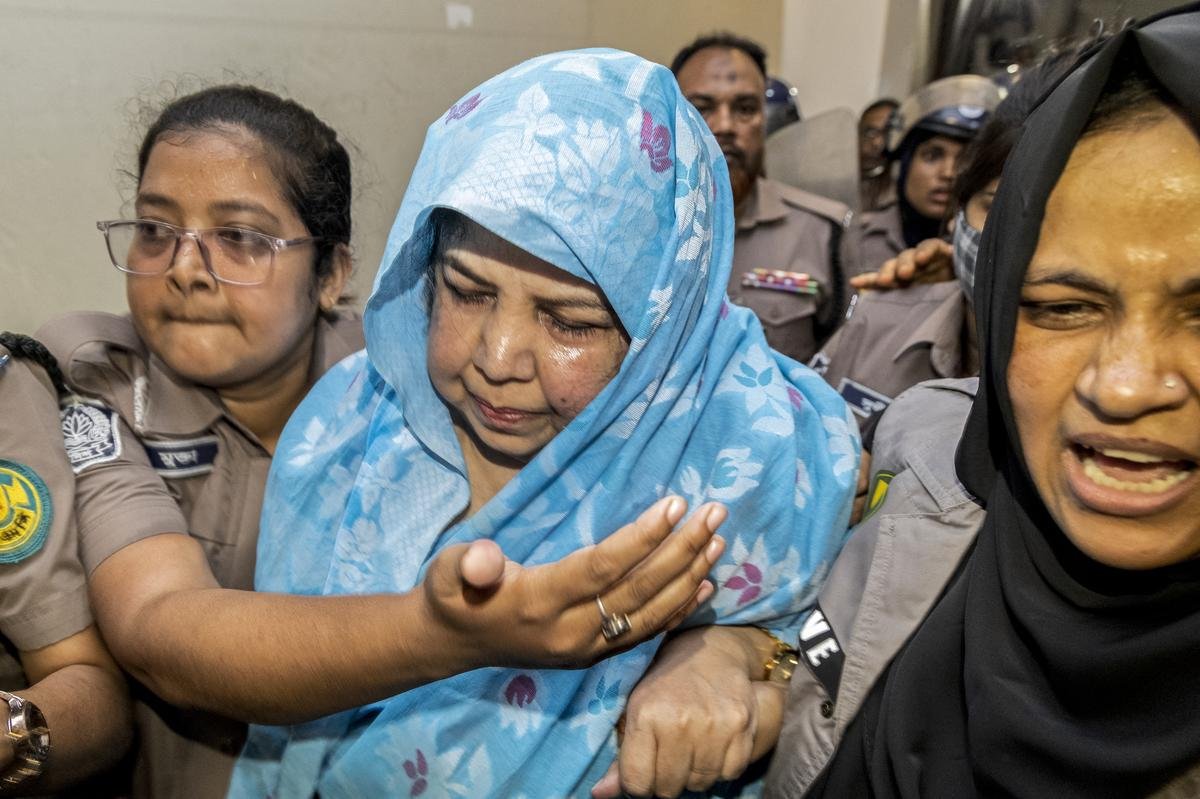
In recent months, Bangladesh has witnessed one of the most striking and politically sensitive developments in its contemporary history—the arrest of Shirin Sharmin Chaudhury, the former Speaker of the Jatiya Sangsad and one of the most prominent constitutional figures of the post-2013 parliamentary era. Her detention, subsequent court proceedings, and reported release into judicial custody have sparked widespread debate about accountability, political transition, and the evolving nature of Bangladesh’s legal and political institutions.
As a Bangladeshi writer observing these events, I find this moment to be more than just a legal incident. It is a reflection of a broader transformation in our political system, where even the highest offices are now subject to judicial scrutiny in a rapidly shifting political environment.
Shirin Sharmin Chaudhury is not an ordinary political figure. She made history in 2013 as the first female Speaker of Bangladesh’s Parliament, serving for over a decade and becoming one of the most recognizable faces of legislative authority in the country. Her tenure, which lasted until September 2024, placed her at the center of parliamentary governance during a politically intense period in Bangladesh’s democratic journey.
However, in early April 2026, her political legacy took a dramatic turn when law enforcement agencies detained her in Dhaka’s Dhanmondi area. According to multiple reports, the Detective Branch (DB) of the Dhaka Metropolitan Police took her into custody in connection with cases linked to violence during the 2024 student-led mass uprising.
Authorities stated that she was being investigated in multiple cases filed across different police stations, including allegations related to incidents of political violence during the turbulent uprising period.
This arrest immediately placed her at the center of national attention, raising questions about the intersection of law, politics, and post-government accountability.
According to police statements and media reports, Shirin Sharmin Chaudhury was named in several cases linked to violent incidents during the political unrest that followed the 2024 mass uprising. One of the most cited cases involves allegations connected to a fatal shooting incident in Rangpur, as well as other cases filed in Dhaka metropolitan areas.
Officials from the Detective Branch confirmed that she had been detained for interrogation and was later “shown arrested” in connection with these cases.
The arrest did not occur in isolation. It came amid a broader legal and political crackdown involving multiple former ruling party figures following the collapse of the previous government structure in 2024. Reports indicate that many senior political leaders have faced investigations or legal proceedings tied to allegations of excessive force, political violence, and administrative misuse of power during periods of unrest.
From a constitutional perspective, this situation represents a significant shift: for the first time in recent memory, a former Speaker of Parliament has been formally arrested and brought under criminal investigation while still being a highly visible political figure.
Following her arrest, Shirin Sharmin Chaudhury was produced before a metropolitan magistrate court. Media reports suggest that her remand was not granted in full, and she was subsequently sent to judicial custody.
This stage of the process is critical in understanding Bangladesh’s legal framework. Judicial custody does not imply conviction; rather, it indicates that the court has determined the need for further investigation while ensuring that the accused remains under legal supervision.
The court proceedings surrounding her case reflect a broader pattern in Bangladesh’s justice system, where high-profile political cases often move through stages of arrest, remand petitions, judicial custody, and further investigation before any final judgment is reached.
At the same time, legal observers have noted that such cases are often deeply intertwined with political narratives, making them highly sensitive in public discourse.
Public Reaction and Political Polarization
The arrest of a figure as senior as Shirin Sharmin Chaudhury has inevitably generated mixed reactions across Bangladesh’s political and civil society spectrum.
Supporters of the legal action argue that no individual, regardless of status or former office, should be above the law. From this perspective, her arrest is seen as a step toward strengthening accountability and addressing past incidents of political violence.
On the other hand, critics raise concerns about the potential politicization of legal processes. They argue that the timing and nature of the charges reflect deeper political transitions and may be influenced by shifting power structures following the change in government dynamics after 2024.
This divide reflects a larger national debate: Is Bangladesh moving toward stronger rule of law, or toward selective political justice?
The truth likely lies somewhere in between, shaped by both institutional reform efforts and political realities.
The arrest and legal proceedings involving Shirin Sharmin Chaudhury represent more than just a single case. They symbolize a broader transformation in Bangladesh’s political and judicial landscape.
Whether viewed as a step toward accountability or as part of political restructuring, the case highlights the fragile balance between law, politics, and institutional trust in Bangladesh.
As the legal process continues, it will be crucial for all stakeholders—judiciary, law enforcement, political actors, and civil society—to ensure that due process is maintained and that justice is not only done but is seen to be done.
Ultimately, this moment may be remembered as a defining chapter in Bangladesh’s democratic evolution—one that tests the strength of its institutions and the maturity of its political culture.


