


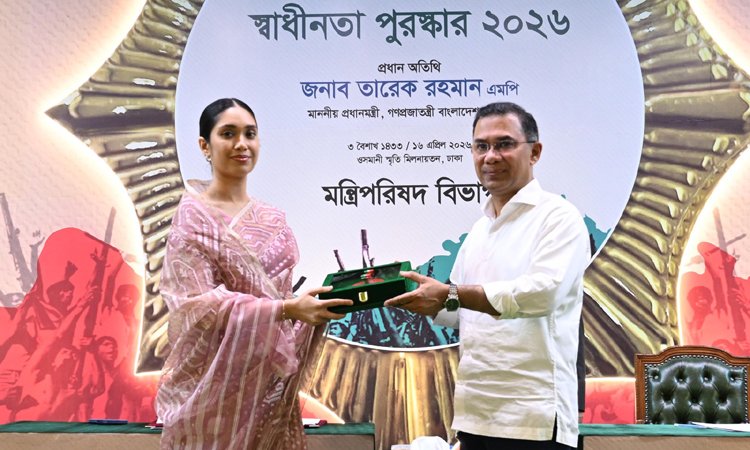
The ceremony in which Barrister Zaima Rahman received the Independence Award on behalf of her grandmother, former Prime Minister Khaleda Zia, was more than a formal state function—it was a deeply symbolic moment that brought together history, legacy, and emotion. Held on April 16, 2026, at the iconic Osmani Memorial Auditorium, the event reflected not only the recognition of an individual but also the enduring influence of a political era that shaped modern Bangladesh.
The Event: A Ceremony of National Importance
The Independence Award—known locally as “Swadhinata Padak”—is the highest civilian honor in Bangladesh, introduced in 1977 to recognize extraordinary contributions to the nation. Independence Award Each year, it is bestowed upon individuals and institutions whose work has had a lasting impact on the country’s independence, development, and cultural identity.
In 2026, the ceremony carried added emotional weight. Among the 15 distinguished individuals honored, Khaleda Zia was awarded posthumously for her “comprehensive contributions to independence, democracy, women’s education, and nation-building.”
Because she had passed away months earlier, the responsibility of receiving the award fell upon her granddaughter, Zaima Rahman—a figure representing the next generation of a prominent political family.
The hall was filled with dignitaries, ministers, diplomats, senior civil and military officials, and family members of the awardees. The program began with the national anthem and religious recitations, followed by formal proceedings led by Cabinet Secretary Nasimul Ghani.
When Prime Minister Tarique Rahman stepped forward to hand over the award, the moment became intensely personal as well as political—a son honoring his late mother, and a daughter accepting that honor on behalf of her grandmother.
A Moment of Legacy: Three Generations on One Stage
Perhaps the most powerful aspect of the event was its generational symbolism.
At the center stood Zaima Rahman—young, composed, and representing a new chapter. Opposite her was Tarique Rahman, now the country’s prime minister, who had himself returned from years of political exile to lead Bangladesh. Between them, in spirit, stood Khaleda Zia—a towering figure whose political life spanned decades.
This convergence of three generations created a rare moment in Bangladeshi political history. It reflected continuity in leadership, but also transformation.
For many observers, the image of Zaima receiving the award was deeply evocative. It was not just about honoring the past; it was about passing forward a legacy.
Khaleda Zia: A Contested but Defining Figure
To understand the significance of the award, one must consider the life and influence of Khaleda Zia.
She was one of the most dominant political figures in Bangladesh for over three decades and the country’s first female prime minister. Her leadership, particularly in the 1990s and early 2000s, played a crucial role in shaping Bangladesh’s democratic trajectory.
She was widely recognized for:
- Leading the movement against military rule
- Strengthening parliamentary democracy
- Advocating for women’s participation in politics
- Expanding education initiatives
At the same time, her career was not without controversy. Political rivalry, allegations, and governance challenges often defined her tenure. Yet, regardless of perspective, her influence on Bangladesh’s political landscape is undeniable.
Her death in late 2025 marked the end of an era.
The Independence Award, therefore, was not just recognition—it was a posthumous acknowledgment of her historical significance.
Zaima Rahman: A New Face in Public Life
While the award honored Khaleda Zia, the spotlight inevitably turned to Zaima Rahman.
A barrister by profession, Zaima has largely remained outside frontline politics. However, her presence at the ceremony—and her role in receiving such a prestigious honor—has elevated her public profile.
Her demeanor during the event was widely noted: calm, respectful, and composed. She walked onto the stage, accepted the medal and certificate, and briefly acknowledged the moment without overt political messaging.
For many, this marked her quiet emergence into the national spotlight.
Though she did not deliver a political speech, her participation itself carried meaning. It suggested continuity, responsibility, and perhaps the possibility of a future role in public life.
The Ceremony in Detail
The award presentation followed a structured and dignified format.
- The Prime Minister presented medals and certificates to recipients or their representatives
- Short profiles of each awardee were read aloud
- Applause followed each recognition
When Khaleda Zia’s name was announced, the hall responded with a particularly strong reaction—reflecting both respect and the emotional resonance of her absence.
Zaima Rahman stepped forward to receive the award. The exchange between her and the Prime Minister was brief but symbolic. It was a moment where personal loss intersected with national recognition.
The ceremony also honored a diverse group of individuals across sectors—Liberation War veterans, scientists, cultural figures, and social activists.
This broader context reinforced the significance of the award as a national institution, not just a political gesture.
Political and Public Reactions
The event generated widespread discussion across Bangladesh.
Supportive Reactions
Supporters of Khaleda Zia and her political legacy viewed the award as long overdue recognition. Many saw it as a corrective step in acknowledging her contributions to democracy and nation-building.
Government officials described the award as a reflection of national gratitude, emphasizing that it transcended political divisions.
Critical Perspectives
However, critics questioned the timing and context of the award. Some argued that honoring a controversial political figure could deepen existing political polarization.
Others viewed the ceremony as part of a broader effort to reshape historical narratives in Bangladesh.
These differing reactions highlight the complexity of Khaleda Zia’s legacy—and the challenges of interpreting it.


