


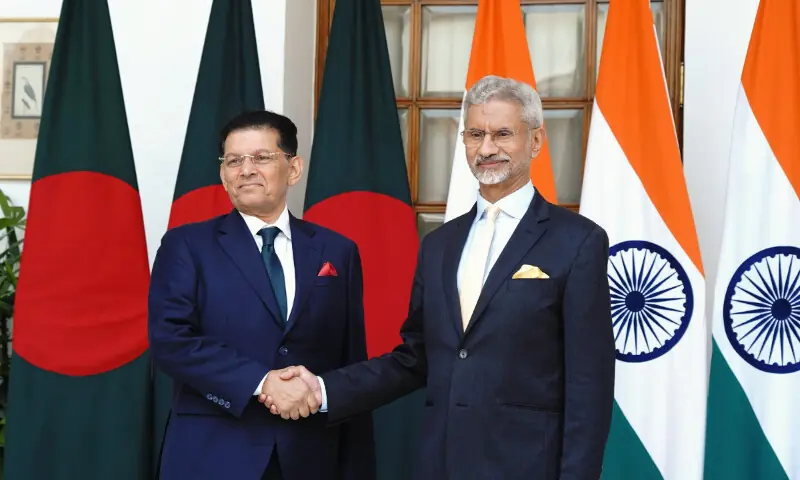
In the evolving landscape of South Asian diplomacy, the recent visit of Bangladesh’s Foreign Minister Khalilur Rahman to India marks a significant and potentially transformative moment in the bilateral relationship between Dhaka and New Delhi. As a Bangladeshi observer of regional politics, I view this visit not merely as a routine diplomatic engagement, but as a carefully calibrated attempt to reset, stabilize, and reimagine one of the most strategically important relationships in our region.
Over the years, Bangladesh–India relations have oscillated between cooperation and tension, shaped by issues such as border management, water-sharing disputes, trade imbalances, migration concerns, and geopolitical alignments. Against this backdrop, the Foreign Minister’s visit carries symbolic as well as practical importance, signaling a renewed willingness from both sides to engage constructively.
A Visit in a Period of Transition
The visit took place during a politically sensitive period in Bangladesh’s domestic and foreign policy environment. Following recent political changes and the formation of a new government, Dhaka has adopted a more “balanced” and “interest-driven” foreign policy approach. The Foreign Minister’s trip to India is widely interpreted as one of the first major diplomatic steps in this recalibration.
According to official statements and media reports, discussions between the Bangladeshi Foreign Minister and Indian External Affairs Minister focused on strengthening cooperation across multiple sectors, including energy, connectivity, trade, visa facilitation, and regional stability.
This agenda reflects a clear recognition that Bangladesh and India are deeply interdependent neighbors, bound by geography, shared history, and economic linkages.
Economic Cooperation: The Central Pillar
One of the most important outcomes of the visit is the renewed emphasis on economic cooperation. Bangladesh reportedly requested increased energy imports from India, particularly diesel and electricity, highlighting its growing energy demands and supply vulnerabilities.
From Bangladesh’s perspective, this is not simply a matter of dependency but of pragmatic regional integration. India remains one of our largest trading partners, and stable energy cooperation can significantly support Bangladesh’s industrial growth and infrastructure development.
At the same time, India also benefits strategically from a stable and economically robust Bangladesh. A prosperous Bangladesh contributes to regional stability, reduces security concerns in India’s northeastern states, and opens new corridors of trade and connectivity.
Thus, the visit reinforced a mutual recognition: economic cooperation is not optional—it is essential.
Diplomatic Reset and Trust-Building
Perhaps the most significant undercurrent of the visit is the effort to rebuild trust between the two countries. Recent years have seen moments of strain, particularly over political developments, border incidents, and differing foreign policy alignments.
During the New Delhi talks, both sides agreed to “constructively engage” and strengthen bilateral relations through established diplomatic mechanisms.
This language may appear formal, but it carries deeper meaning. It suggests an acknowledgment that past tensions should not define future relations. Instead, both countries appear willing to prioritize stability and pragmatic cooperation over ideological differences.
From a Bangladeshi viewpoint, this is encouraging. A stable relationship with India is not just desirable—it is necessary. Our two countries share over 4,000 kilometers of border, making us natural partners in managing security, trade, and environmental challenges.
Key Outstanding Issues: Still Unresolved but Managed
Despite positive signals, several longstanding issues remain unresolved. These include:
- Water-sharing disputes, particularly over transboundary rivers such as Teesta and Ganges
- Border killings and security concerns
- Trade imbalance and non-tariff barriers
- Visa and mobility challenges for Bangladeshi citizens
- Geopolitical sensitivities involving regional alliances
While these issues were not fully resolved during the visit, both sides agreed to continue discussions through diplomatic channels.
This is an important point. The visit did not aim to solve all problems immediately. Rather, it aimed to prevent escalation and keep dialogue open.
Geopolitical Context: A Balancing Act
South Asia today is shaped by competing global influences, particularly between major powers such as China, India, and Western partners. Bangladesh, situated at the heart of the Bay of Bengal region, has increasingly pursued a balanced foreign policy, engaging with multiple partners while safeguarding national interests.
India, on its part, views Bangladesh as a key strategic neighbor in terms of security, connectivity, and regional influence. Reports suggest that New Delhi is also keen to counterbalance growing external influence in Bangladesh by strengthening bilateral ties.
In this context, the Foreign Minister’s visit is not just bilateral—it is geopolitical. It signals Bangladesh’s intention to maintain constructive relations with India while preserving its diplomatic autonomy.
Energy, Connectivity, and Regional Integration
One of the most promising aspects of the visit is the focus on regional connectivity. Discussions reportedly included cooperation in energy supply chains, cross-border infrastructure, and trade facilitation.
Energy cooperation in particular stands out. Bangladesh’s growing industrial base requires stable and affordable energy, while India has the capacity to supply and transit energy resources. This creates a natural synergy.
Similarly, improved connectivity—rail, road, and maritime—can transform the Bay of Bengal region into a hub of economic integration. Such initiatives not only benefit governments but also ordinary citizens through increased trade, employment opportunities, and mobility.
Public Perception in Bangladesh
Within Bangladesh, public opinion on India–Bangladesh relations is complex and often divided. On one hand, there is recognition of India’s role in Bangladesh’s independence and its importance as a major trading partner. On the other hand, concerns persist regarding trade imbalances, border issues, and perceived asymmetry in the relationship.
The Foreign Minister’s visit is therefore significant domestically as well. It sends a message that Bangladesh is actively engaging with India from a position of national interest, rather than passive dependence.
As a Bangladeshi writer, I believe this nuance is important. Diplomacy is not about alignment or opposition—it is about balancing interests while safeguarding sovereignty.
Looking Ahead: A Cautious Optimism
The visit does not mark the end of challenges in Bangladesh–India relations. Instead, it represents a cautious but meaningful step toward normalization and deeper cooperation.
The success of this diplomatic engagement will depend on follow-up actions—particularly in areas such as water-sharing agreements, trade reforms, and improved people-to-people connectivity.
However, the tone set by both governments during this visit is encouraging. It reflects a shared understanding that despite differences, cooperation is not only possible but necessary.
Conclusion
The recent visit of Bangladesh’s Foreign Minister to India should be viewed as more than a diplomatic formality. It is a strategic effort to reset relations, rebuild trust, and strengthen cooperation between two neighboring countries whose futures are deeply intertwined.
For Bangladesh, the challenge lies in engaging India constructively while preserving policy independence and national interest. For India, the challenge is to recognize Bangladesh as an equal partner in regional stability and development.
If both sides succeed in maintaining this balance, the visit may be remembered not just as a diplomatic event, but as the beginning of a more stable and mature phase in Bangladesh–India relations.


